
Sponsored By: Keystone

With Nisa Khan
5/20/19 – Lighting Episode 76(Full Version) – Nisa Khan 1:01:40
No one likes to get punched in the eye, but according to Dr. Nisa Khan, that is what certain LED lights are doing to us right now. According to her “lighting dropped science a long time ago.” LED lighting is unlike any other light source we have dealt with and is not something we should take lightly. Is it time to bring science back to lighting?

Your Resources
– Keystone Technologies
– National Association of Innovative Lighting Distributors (NAILD)
– Nisa’s LinkedIn
– Nisa’s Book – Understanding LED Illumination
Dr. Khan’s presentation is excellent! It is clear to those with understanding of Ostrogradsky instability that simple theory of geometric optics as introduced by Lambert is incomplete and leads to wrong conclusion. Lighting theory must be derived from quantum electrodynamics (QED), leading to Coulomb’s law and naturalness of divergent light. Only great scientists like Dr. Kahn perceive light as it truly exists in space-time manifold. Unfortunately, the deep state of lighting industry and its so-called associations such as CIE and IES work against educating people of equivalence between electromagnetic and electrostatic theory, seeking instead to sell products that harm everyone.
Thank you for sharing this important information. Indeed, “lighting dropped science a long time ago.”
Let’s hope illuminating podcasts like these help to rectify that 🙂
What I talked about in this podcast are scientifically validated in my paper that now can be found here:
https://www.researchgate.net/publication/333429682_A_novel_derivation_of_near-field_intensity_distribution_of_LEDs_reveals_why_high-power_inorganic_LED-based_lamps_produce_enormous_luminance_and_glare
I am publicly challenging anyone who would disagree with me with all I presented in this paper. However, when I challenge my adversaries, I ask that outstanding university math and physics professors who teach advanced calculus and electromagnetic theory be present in the audience. I shall be publishing the disturbing and erroneous reviews I received on this paper from reviewers associated with OSA and other journals. My rebuttals will follow each erroneous review in these documents to come.
Dr. M. Nisa Khan
Some of the erroneous and disturbing reviews of my paper talked about in my previous comment here above are now available for public to view and study. These reviews are followed by my rebuttals and Part I of such review-rebuttal can now be found on ResearchGate:
https://www.researchgate.net/publication/333579278_Peer_Reviews_and_Author_Rebuttals_-Part_I_for_Manuscript_A_Novel_derivation_of_near-field_intensity_distribution_of_LEDs_reveals_why_high-power_inorganic_LED-_based_lamps_produce_enormous_luminance_an
Additional review-rebuttal documents will follow shortly.
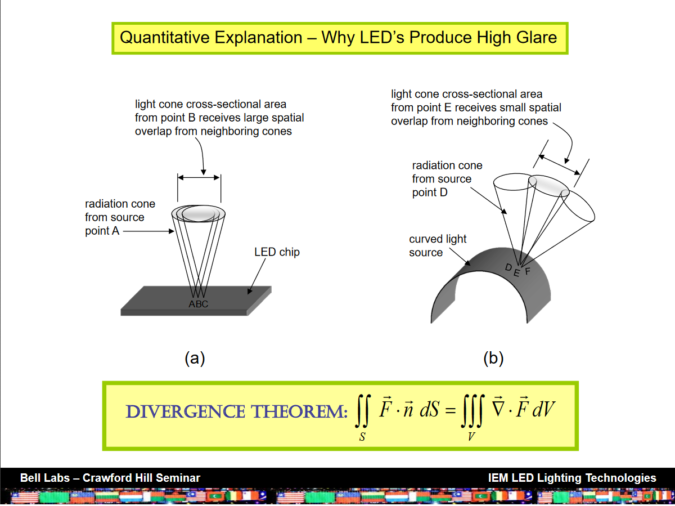
Part II of my rebuttals against more erroneous peer-review is now available in ResearchGate. This document contains the erroneous reviews from the reviewer chosen by the Optics Express Journal by OSA Publishing and my rebuttal against these reviews. This article is of particular importance for this podcast since I drew crude sketches to show what the luminance distribution at an LED surface looks like during the podcast and verbally argued why this is a problem for lighting. I also mentioned that such a Gaussian-like 2D profile on an LED surface is directly linked to the Lambertian light distribution the LED produces in 3D near-field. These descriptions and arguments are presented in this rebuttal document in a rigorous scientific manner and my hope is that very good mathematicians and optical physicists will take away a great deal of unique and valuable information from this article.
https://www.researchgate.net/publication/333632828_Peer_Reviews_and_Author_Rebuttals_-Part_II_for_Manuscript_A_Novel_derivation_of_near-field_intensity_distribution_of_LEDs_reveals_why_high-power_inorganic_LED-_based_lamps_produce_enormous_luminance_a
More review-rebuttal documents are yet to come.
Part III of my rebuttals against more erroneous peer-review is now available in ResearchGate. This document contains the erroneous reviews from the reviewers chosen by the Optical Review Journal by Springer and overseen by the Japanese Optical Society, and my rebuttal against these reviews. It is very disturbing that so many laser and LED scientists from JOS believes that the light inside an active layer of and LED is emitted isotropically or that this light produces isotropic radiation. This a violation of electromagnetic theory because light particles/elements contained in a rectangular volumetric region cannot emit light isotropically. Studying basic electromagnetic theory from J. D. Jackson would establish how light is emitted from such a 3D slab device. The entire problem can be solved by carrying out a waveguide simulation in 3D finite spatial domain. I urge the reviewers to learn this basic knowledge if they are to work in the laser and LED field because without such knowledge, one stands to produce wrong scientific results and end up creating dangerous light and lighting devices such as today’s LED auto headlamps and streetlamps.
https://www.researchgate.net/publication/333677985_Peer_Reviews_and_Author_Rebuttals_-Part_III_for_Manuscript_Derivation_of_near-_field_intensity_distribution_of_LEDs_reveals_why_high-power_inorganic_LED-based_lamps_produce_enormous_luminance_and_glar/stats
Part IV of my rebuttals against yet another erroneous peer-review is now available in ResearchGate. During this podcast, I was asked by Michael Colligan whether my work is peer-reviewed. Well, my question to the optics and lighting industry is now, “Are there any peers who can review my recent work on LED lighting?”
You be the judge.
https://www.researchgate.net/publication/333731293_Peer_Reviews_and_Author_Rebuttals_-Part_IV_for_Manuscript_Derivation_of_near-_field_intensity_distribution_of_LEDs_reveals_why_high-power_inorganic_LED-based_lamps_produce_enormous_luminance_and_glare
Part V of my rebuttals against yet another set of erroneous peer-review is now available in ResearchGate. Interested scientists and engineers in the optics and lighting industry are encouraged to read this document as well as the other documents I mention in this forum.
I would be interested to hear from anyone who thinks that the peer-review process in the optics and lighting industry is working reasonably. From my experience, the peer review process in the optics and lighting industry is fatally flawed whether or not one involves LED lighting. I say this because not only the so-called peer-reviewers have no good understanding of LED and laser optics and lighting in general, they lack proper understanding and adequate knowledge of the fundamentals behind optics and lighting. These happen to be Maxwell’s Equations, Gauss’ Divergence Theorem, and calculus with analytic geometry. The general public is now the victim of such ignorance and ineffectiveness.
https://www.researchgate.net/publication/333828108_Peer_Reviews_and_Author_Rebuttals_-_Part_V_for_Manuscript_Why_inorganic_LEDs_have_tremendous_luminance_and_glare_and_how_to_mitigate_glare_in_LED_lamps
Part VI of my rebuttals against another set of erroneous peer-review is now available in ResearchGate. Interested scientists and engineers in the optics and lighting industry are encouraged to read this document as well as the other documents I mention in this forum.
Reviewers appear to lack knowledge in spherical coordinates, what Maxwell’s Equations really mean, what boundary conditions apply to lightwaves in different media, and finally what lighting science is. My rebuttals against the erroneous reviews establish what I have stated here. I welcome excellent physics & mathematics professionals/academics of the world to discuss these in person to broadly establish LED lighting’s rigorous science.
https://www.researchgate.net/publication/333934457_Peer_Reviews_and_Author_Rebuttals_-Part_VI_for_Manuscript_Derivation_of_near-_field_intensity_distribution_of_LEDs_reveals_why_high-power_inorganic_LED-based_lamps_produce_tremendous_luminance_and_gla
Part VII of my rebuttals against another set of erroneous peer-review is now available in ResearchGate. Interested scientists and engineers in the optics and lighting industry are encouraged to read this document as well as the other documents I mention in this forum.
Among the many fundamentals the Journal of Applied Physics reviewers missed are not knowing the difference between a finite and an infinitesimal source; what Maxwell’s Equation and Gauss’ Divergence Theorem say in plain English; and the difference between the 2D light distribution that a laser or LED produces on its surface versus what 3D light distribution they produce in the near-field space.
I welcome excellent physics & mathematics professionals/academics of the world to discuss these with me in person to broadly establish LED lighting’s rigorous science.
https://www.researchgate.net/publication/334469844_Peer_Reviews_and_Author_Rebuttals_-Part_VII_for_Manuscript_Why_inorganic_LEDs_have_tremendous_glare_and_how_to_mitigate_it
So the sun is spherical so it emits light in a “safe manner” and a flat 1 mm x 1mm LED is dangerous. . .
Hmmm, a 1 mm x 1 mm area of the sun differs from a perfect plane by 0.7 femtometers, less than half the diameter of a proton or neutron. That is 100,000 times less than the diameter of a nitrogen atom inside a GaN LED. Given the inherent undulations of an atomically flat plane in a semiconductor, the actual curvature is orders of magnitude greater than a perfect spherical light source the size of the sun.
A single misplaced atom at the surface of an LED chip represents orders of magnitude more curvature than a light source the size of the sun.
Nitrogen has an atomic diameter of about 56 pm (picometers), galllium 136 pm and tungsten 193 pm. At the atomic level the surface of GaN has more inherent curvature than tungsten, yet tungsten filaments are “safe” because they have a surface with a higher curvature?
I believe you also overlooked the fact that the majority of luminous flux from a white LED is emitted from phosphor particles, most of which are approximately spherical. I would also point out that any light emitted by an LED chip underneath a layer of phosphor particles that is not converted to a different wavelength is undergoes a dozen or more changes of direction at the multiple phosphor/encapsulant interfaces it encounters.
Eric Bretschneider,
You will not understand any of what I have said unless you learn about optical waveguide theory and how optical waveguide modulators and other waveguide active and passive semiconductors are made in integrated photonics learn why they work they way they do. Focusing on the size of an atom or molecule is the wrong thing to do. It is the arrangement of atom, molecules and elements that dictate the how light is emitted from a solid. Phosphor particles don’t make much of a difference and the data taken for a white LED therefore also shows that a Lambertian LID is produced. This is because the size of a phosphor particle is many times larger than the wavelength of light. All of what I am saying falls out of Maxwell’s Equations, Gauss’ Divergence Theorem and electromagnetic boundary conditions. You need to become proficient at these in order to understand light emission for inorganic LEDs and lasers, with or without any coating over them. The same fundamental theory applies to any other light source including the sun and fire. These do not generate Lambertian-like spatial light distribution and therefore aren’t directional light sources. LEDs and lasers are directional light sources for a reason. The data have been taken to show what I am saying many millions of times. Your arguments aren’t valid. You will need to understand what I have written in my paper referenced here. This will require having the background of electromagnetics, waveguide theory, semiconductors, and advanced calculus with analytic geometry. Such background is not common among many and that is unfortunately the problem. Nearly everything I have said and done is out in the open now. Any serious arguments against what I have written should be taken in a public forum where excellent mathematics, physics, and electrical engineering professors with strong electromagnetics background must be present in such a public forum.
M. Nisa Khan
Respectfully, you need to become aware of real world examples that refute your positions. You state that LEDs are flat, yet they are not. The light is not even created at the surface rather it is created by electron hole recombination in the quantum wells of the active region which is typically located a few tenths of a micron below the surface.
Your position that phosphor particles does not make much of a difference is a clear divergence from reality. The majority of the photons emitted by a white LED are created by phosphor particles and the vast majority of the luminous flux comes from the light emitted by the phosphor particles.
The LEDs used for lighting are primarily phosphor light sources and you continue to ignore that simple fact.
You are misapplying Gauss’ Divergence Theorem and Maxwell’s equations. If your theory were true then I could heat a flat metal plate to 1000 C and the light emitted would only be visible to a viewer whose eyes were directly perpendicular to the surface of the plate.
Respectfully I have a background in electromagnetics, waveguide theory, semiconductors, advanced calculus and analytical geometry (as well as linear algebra and some quantum mechanics). I have far more experience in the real world and I believe most in the lighting industry can understand that your theoretical results are not supported by reality.
You may consider your theory to be beautiful (and many mathematical results are described as such), but whatever beauty your solutions hold they are slain by the ugly facts of reality. Arguing against.
It is curious that you wish a public forum, but place severe restrictions on the audience which I believe would be contrary to a public forum.
Eric Bretschneider,
Everything I have said and published have been proven by real experiments by many others as well as me for 100’s of years, in fact. Your arguments are all invalid. Anyone can prove this by justifying Lambert’s Law and according to Lambert’s law, as well as Gauss’ Law, Maxwell’s Equations and electromagnetic boundary conditions, an inorganic LED with or without a phosphor coating produces a Lambertian luminous and radiant intensity distribution. This has been measured millions of times by many laboratories. If you don’t understand that, I am afraid you don’t understand advanced calculus, analytic geometry, and electromagnetic theory. A few outstanding physicists, mathematicians and electrical engineers have already understood what I am saying and fully agree with me after I have explained it all to them in person. They didn’t get it all on their own. But they do get optics and electromagnetics much better than you have demonstrated. Their numerous publications and worldwide fame establish that. I don’t have to say that. I can lecture in public forum, as I said before, as long as five university professors from several outstanding colleges are present and they need to be professors of mathematics, physics and electrical engineering. I invitation for this has been out there for many years. I’ll even pay for this and put up a wager of $100,000.00 of US dollars. I’ll leave you with one question since you love to argue with me. Why does an inorganic LED with or without phosphor generate a Lambertian radiant intensity distribution and why the sun, incandescent lamp, and a gas-discharge lamp never produce an Lambertian radiant intensity distribution? If you understand math and physics behind Lambert’s Law, you should be able to answer this question. If you don’t believe an inorganic LED with or without phosphor produces a Lambertian radiant intensity distribution, you don’t know anything important in optics or lighting. I also suggest that you stop commenting here as this is not productive. As Michael Colligan said, if you don’t like what I said in the podcast, you can go to his show.
Apparently you are unaware that a flat surface heated to incandescence emits a Lambertian emission pattern. Contrary to your claims it is not difficult to modify a Lambertian emission using conventional optics. The photons emitted from an LED do not ignore the principles of refraction and reflection. The light emission pattern from LEDs may readily be modified with conventional optics to quite complex patterns such as type II and type III medium patterns suitable for streetlights. Conventional optics can also modify the light emission pattern from LEDs into well focused beams with beam angles <10 degrees.
I never said that an inorganic LED without a phosphor doesn't emit light in a Lambertian distribution. You seem to be unaware that while it is possible to for an inorganic LED (without phosphor) to emit a Lambertian distribution. It is also possible for an inorganic LED with a phosphor to emit a Lambertian distribution. OLEDs also emit a Lambertian distribution as do TFLEDs.
Further if you review the initial products developed by Luminus Devices (inorganic LEDs) these did not emit light in a Lambertian distribution.
You can continue you theoretical arguments, but you seem to be completely oblivious to the abundance of real world examples that contradict your theoretical positions. The point of science is that a theory should make testable predictions. If experimental data or real work experience contradicts a theory then is the theory wrong or the world. Mother nature makes no assumptions and always solve equations correctly.
You want a public forum, but you demand to be able to choose the audience – another contradiction. You want to pick and control the audience, perhaps because you fear common sense.
If I heat a ball bearing to incandescence I do not see it as a point source – why? Your theoretical arguments say that I should only see the point on the surface that is perpendicular to my line of sight.
By your arguments light that is transmitted through a pane of glass should have the same properties you demand that LEDs possess. The light in LEDs is not created by/at the surface. If you knew the details of LED architecture you would be aware of this.
Submissions are open for Light Fair – submit for a panel discussion and bring a cashier's check.
Eric Bretschneider,
You are writing a whole bunch of things I didn’t say and you have done this before. In my post above, I said inorganic LEDs with or without a phosphor coating produces a Lambertian radiant intensity distribution. I didn’t say otherwise. I have my wager out there and it is under the circumstances where my work will be judged by valid experiments and academic theories that outstanding professors at very well-known colleges around the world can understand. I don’t need to pick who they are; but if they teach Gauss’ Law, advanced calculus, Maxwell’s Equations and electromagnetic theory, they should follow what I am saying. These are my restrictions. Let the wider scientific and academic world judge me. I do not wish to be judged by IES or other orgs heavily associated with lighting conferences. Let this be our last piece of talk.
I have asked you to not engage in conversations with me before. In private or in public. As such, I ask Michael Colligan to no longer post your comments here. You can write other public documents about my podcast and other publications elsewhere.
Part VIII of my rebuttals against another set of erroneous peer-review is now available in ResearchGate. This document provides rebuttals to the erroneous reviews from the revised manuscript I submitted to Journal of Applied Physics. The rebuttals are provided against the second round of reviews on my paper from JAP.
Among the many errors the Journal of Applied Physics reviewers made in this review are claiming that a LED is a point source that radiates over 4 pi steradian, and not recognizing the behavior of a Lambertian light distribution in 3D space. These are the basics all optics and lighting professionals must recognize. Due to the lack of such understanding, high-power and high-intensity LED lamps continue to blind us and these should not be allowed in the public domain as they are very dangerous to our vision and health.
https://www.researchgate.net/publication/334657223_Peer_Reviews_and_Author_Rebuttals_-Part_VIII_for_Manuscript_Why_inorganic_LEDs_have_tremendous_glare_and_how_to_mitigate_it_This_document_is_a_continuation_of_Part_I_through_Part_VII